Australian Indigenous Aboriginal Folk Art
Painted Emu Eggs
Emu eggs are painted by Australian Aborigines as a craft to offer souvenirs for visitors to their communities. The egg contents serve as an important source of nutrition for people in the bush. Emu eggs are taken from the nest when the adult emu is distracted and leaves to investigate the source of the distraction, often caused by an emu caller.
Prices for our Australian Indigenous Folk Art items include FREE shipping to any address within the 48 mainland United States.
Shipping to other destinations at the purchaser’s expense may be arranged after the purchase has been made.
We do NOT ship to Australia.
For a larger image, more
information & prices, click
on any small picture below

Emu eggs are painted by Australian Aborigines as a craft to offer souvenirs for visitors to their communities. The egg contents serve as an important source of nutrition for people in the bush.
This emu egg has been hollowed and emptied of contents and then painted by an authentic Australian Aboriginal artist in the traditional desert Aboriginal dot technique. We acquired it from Muk Muk, in Alice Springs, NT Australia in 2001.
We guarantee the authenticity of this item and your satisfaction if you purchase it. If you are unhappy with this authentic indigenous-painted emu egg when you receive it, let us know within 10 days and we will refund your purchase price upon receiving the undamaged returned item.
#AGKC49

Australian Painted Emu Egg
Emu eggs are painted by Australian Aborigines as a craft to offer souvenirs for visitors to their communities.
This emu egg has been hollowed and emptied of contents and then painted by an authentic Australian Aboriginal artist in the traditional desert Aboriginal dot technique. We acquired it at Muk Muk in Alice Springs, NT, Australia in 2001
We guarantee the authenticity of this item of indigenous craft, and your satisfaction with it. If you are unhappy with it for any reason, let us know within 10 days, and we will refund your purchase price when the undamaged product arrives at our base in Fort Myers, FL.
#AGKC50
Australian Tiwi Painted Shells
Aboriginal residents of Bathurst and Melville Islands (Tiwi Islands) are part of Australia but have a different history from Aborigines on the Australian mainland. The Tiwi Islands are located in the Arafura Sea, an ample resource for Tiwi craft persons, about 45 minutes by small aircraft from Darwin on Australia’s northern coast. The shells are painted with traditional Tiwi rarrk and offered as souvenirs to visitors.
For a larger image, more
information & prices, click
on any small picture below

Australian Aboriginal painted shells by a Tiwi artist from Milingimbi on the shore of Arnhemland, Northern Territory.
Painted in traditional Tiwi rarrk designs. The Tiwi Islands of Bathurst and Melville sit in the Arafura Sea about 45 minutes by air north of the Australian mainland. Milingimbi, on the mainland coast is also a Tiwi community.
Shells are harvested by residents and decorated with designs that had their origin thousands of years ago. In this way, they become a source of income for the artists that sell them as souvenirs to Tiwi Islands visitors. We guarantee the authenticity of this item and your satisfaction with it or we will refund your purchase price. If you are unhappy with this authentic paint shell from Australia, let us know within 10 days and we will credit your charge account as soon as the undamaged shell reaches our base in Fort Myers, FL.
4" high x 2" wide. #AGCV69

This Australian Aboriginal painted shell is from Munupi Arts and Crafts Association, Melville Island, one of two sister Tiwi Islands in the Arafura Sea, about 45 minutes by small aircraft north of Darwin in Australia’s Northern Territory.
The Aborigines in residence on the Tiwi Islands are Australians through and through but of a different tribal lineage from those on the mainland.
The salt waters of the Arafura Sea provide shells as media for artistic expression and to supply financial income from visitors to the islands.
We guarantee both the authenticity of this painted shell and your satisfaction with it. If you are unhappy with it for any reason,when you receive it, let us know within 10 days. We will refund your purchase price promptly after receiving the undamaged shell at our Fort Myers, FL base.
3 1/4" x 3 3/4" #AGCV72

Australian Aboriginal painted shell, Munupi Arts and Craft Association, Melville Island, one of two islands making up the Tiwi Islands, situated in the Arafura Sea about 45 minutes by light aircraft from Darwin, NT. Currents of the Arafura, bring an abundance of shells to their craftspeople.
The Tiwi Aboriginal residents of Melville and Bathhurst Islands are Australian citizens, but come from a different tribal linage than the Aborigines of the Australian mainland. They have different Dreamings and different designs that portray them.
The symbols are called ‘rarrk” and they are unique to the artists allowed by tradition to paint them. Authenticity guaranteed, as is your satisfaction with this indigenous product.
If you are unhappy with it for any reason after you receive it, let us know within 10 days. We will refund your purchase price as soon as the undamaged product arrives at our Fort Myers, FL base.
8”. #AGKD87

Australian Aboriginal Tiwi painted shell from Milingimbi, a Tiwi community on the Arafura coast of the Australian mainland, Northern Territory.
Aboriginal residents of Milingimbi are part of Australia but have a different history from Aborigines deeper into the Australian mainland.
The Arafura Sea is an abundant source of shells for Tiwi craftspersons. This shell was painted with traditional Tiwi rarrk. Emu feathers were attached.
Acquired in 2001 at , Milingimbi, NT, Australia. We guarantee the authenticity of this unique item of shell art. We also guarantee you will be satisfied with this item and this transaction or we will refund your purchase price.
If you are dissatisfied for any reason let us know within 10 days. You purchase price will be refunded as soon as the undamaged item returns to our Fort Myers, FL base.
7" x 2 1/2" wide. #AGKD33
Australian Hybrid Pottery & Pottery Figures
Not purely an indigenous product; the basic objects are molded, kiln-fired pottery created by a non-native studio in Alice Springs. Then they are painted by traditional Aboriginal women in designs according to their culture.
For a larger image, more
information & prices, click
on any small picture below

This pottery figure is a kiln-fired kangaroo effigy, molded by Walkabout in Alice Springs, NT, Australia, painted by native Aborigines using the traditional indigenous dot technique.
This is not purely an indigenous product. The basic figure is molded, kiln-fired pottery created by non-native small business named “Walkabout”. The Aboriginal contribution is painting in traditional Aboriginal designs by indigenous women. We call them “hybrids” and classify them as Australian Aboriginal folk art.
Kangaroos and their cousins, wallabies, are native to Australia and are found in abundance in the Australian outback. They are marsupials and are as symbolic of the continent and country as any animal.
We guarantee the authenticity of this unique item of indigenous art. We also guarantee you will be satisfied with this item and this transaction or we will refund your purchase price.
If you are dissatisfied for any reason, let us know within 10 days. You purchase price will be refunded as soon as the undamaged item returns to our Fort Myers, FL base.
4" x 4" #AGPG68

Frilly Lizard pottery figure, molded and kiln-fired by non-native company named “Walkabout”. This frilly lizard figure was provided to an Aboriginal woman to paint in her traditional dot art technique.
This not a purely Aboriginal art product since its origin as pottery was produced by a non-native entrepreneur in Alice Springs, NT, Australia. Given the significant contribution of an Aboriginal artist to turn it into “art”, we have chosen to call this hybrid art and classify it as Aboriginal folk art
The frilly lizard is a commonly seen creature in the Australian outback and in many nature videos. As it runs to challenge a threat, its neck fringe expands to make it look larger and more menacing.
The designs painted on it are traditional Aboriginal dot patterns and tracks. This is a fascinating bit of Australiana molded in Alice Springs in the heart of the Outback and painted by an indigenous woman according to her inspiration. ca 2001-
We guarantee the authenticity of this unique item of indigenous art. We also guarantee you will be satisfied with this item and this transaction or we will refund your purchase price.
If you are dissatisfied for any reason, let us know within 10 days. You purchase price will be refunded as soon as the undamaged item returns to our Fort Myers, FL base.
5 1/4" x 3" #AGPG79

Australian pottery bird, with open mouth, decorated with traditional dot patterns and iconography.
The form was molded and fired at Walkabout, a non-Aboriginal entrepreneurial studio in Alice Springs, NT, in the heart of the Outback,then painted by an indigenous Aboriginal woman based on her native inspiration. ca. 2001
Because of the combined European and indigenous involvement, we define these items as “hybrid” indigenous folk are objects.
We guarantee the authenticity of this unique item of indigenous art. We also guarantee you will be satisfied with this item and this transaction or we will refund your purchase price.
If you are dissatisfied for any reason, let us know within 10 days. You purchase price will be refunded as soon as the undamaged item returns to our Fort Myers, FL base.
2" x 1 1/2" #AGPG83

Australian Aboriginal pottery figure, koala and kit, studio molded and fired, hand-painted in dot technique by an Aboriginal woman in accordance with her tradition.
This is not a purely Aboriginal product. It was a collaboration between a non-Aboriginal owner of a pottery studio, Walkabout, who molded and fired the figure that was then painted by the Aboriginal artist. We choose to call it a hybrid and classify it as aboriginal art.
The koala is a marsupial, native to Australia and nowhere else. It is very docile, almost slothful, and sits high in a certain eucalyptus tree, the leaves of which constitute its diet. One of the favorite things for visitors to Australia is to get their pictures taken holding a koala.
We guarantee the authenticity of this unique item of indigenous art. We also guarantee you will be satisfied with this item and this transaction or we will refund your purchase price.
If you are dissatisfied for any reason, let us know within 10 days. You purchase price will be refunded as soon as the undamaged item returns to our Fort Myers, FL base.
4 ¼" x 3½" #AGPG85
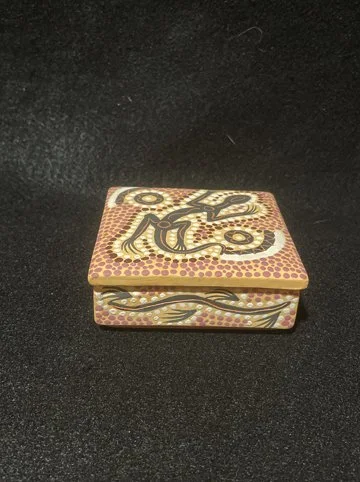
Australian hybrid pottery box. square with lid. Fired at Walkabout in Alice Springs, NT, a non-native enterprise, then hand-painted by an indigenous Australian Aborigine artist in traditional Australian Aboriginal dot technique.
The design features a silhouetted lizard on the top and representation of a lizard track on two sides and site symbols on two sides.
We define this as hybrid Australian Aboriginal art because it combines the skills and artistic vision of both the European entrepreneur and the indigenous painter.
We guarantee the authenticity of this unique item of indigenous art. We also guarantee you will be satisfied with this item and this transaction or we will refund your purchase price.
If you are dissatisfied for any reason, let us know within 10 days. You purchase price will be refunded as soon as the undamaged item returns to our Fort Myers, FL base.
1 1/2" x 4" #AGPH30

Australian hybrid pottery vase, globular with a narrow upright opening and painted with traditional dot patterns and iconography, including honey ants. The vase was fired at non-Aboriginal studio, Walkabout, in Alice Springs, then painted by an indigenous woman according to her native inspiration. ca. 1993.
We guarantee the authenticity of this unique item of indigenous art. We also guarantee you will be satisfied with this item and this transaction or we will refund your purchase price.
If you are dissatisfied for any reason, let us know within 10 days. You purchase price will be refunded as soon as the undamaged item returns to our Fort Myers, FL base.
4 3/4" high x 4 1/2" diameter. #AGP188
Australian Aboriginal Artifacts
A selection of Australian Aboriginal tools and implements:
a boomerang, woomeras, an emu caller and didgeridoos.

Australian Aboriginal artifact, emu caller, Yirrkala/Nhulumbuy.
Often confused with didgeridoos, an Aboriginal percussion instrument used to created a low, rasping sound when blown with continuous breathing.
Australian Aborigines use "emu callers" to attract emus. The sound is made by tapping one end with the hand. This creates a sound that gets the interest of an emu and lures it from its nest so that the emu eggs can be safely removed by the egg hunter.
An emu caller is created the same way as a didgeridoo, using branches of gum tree which have been hollowed out by termites. This one goes beyond mere painted decoration with the artist incising designs into the soft wood.
Authenticity guaranteed. Acquired at Nambara Community in 1994. ca. 1994. Certificate of Authenticity provided if requested.
31 1/2" long. #AGK084

Australian Aboriginal didgeridoo, tapered to bottom, extensive paint and incision, acquired in Adelaide, South Australia, in 1975.
This is arguably the most beautiful didgeridoo ever carved. Look closely at the inscription carved almost full 58” length of the instrument. The sound is equally impressive. #AGK173

Carved wood Aboriginal boomerang showing significant wear from use, each end of the front side has enscribed images of "crosses", which may refer to the Southern Cross, a celestial formation in the Australian skies.
This is a genuine piece of indigenous Australian Aboriginal material culture of unknown age, carved by once known indigenous Australian.
We acquired it from the estate of a 30-year collector of tribal artifacts.
Certificate of Provenance included upon request.
27" x 3" #AGKD66

Australian Aboriginal artifact, woomera, (spearthrower) carved wood with extensive etching inscribed front and reverse side., tip secured to the thrusting end, gummy substance secured to the handle.
From the collection of Stan Moriarty, Sydney, Australia, following his death in 1978, through Peter Hocking. Acquired by us in 1996. Age estimated at ca. 1950s. This is a genuine piece of indigenous Australian Aboriginal material culture at least 50 years old.
29 3/4” long #AGK171

Carved wood Aboriginal woomera spearthrower showing significant wear from use.
The knob handle is secured by a gummy substance. The launch "pin" is secured also. This is a genuine piece of indigenous Australian Aboriginal material culture of unknown age. Acquired from the estate of a 30-year collector of tribal artifacts. Certificate of Provenance included upon request.
Please note: There is a crack in the body of the piece, not apparent unless the wood is flexed.
33" x 4" #AGKD67

Didgeridoo, made from a hollowed eucalyptus branch, wax mouthpiece, painted with Australian Aboriginal Dreamtime designs.
This is a musical (percussion) instrument with deep roots in tribal culture and is still used by Aborigines for tribal ceremonies and social events.
This one is 48" long and plays with a hauntingly distinctive sound. ca. 1994. We acquired it in Darwin, NT at the Raintree Gallery. Artist once known.
48” long #AGK124

Australian Aboriginal ceremonial dance wand, wood in a boomerang shape, painted with a serpent image. Acquired from the Raintree Gallery in Darwin, NT, Australia. Gallery proprietor described it as carved to be used in dances intend symbolize physical combat, a way two Queensland area clans settled disputes without incurring injuries. She estimated its age as ca. 1960s.
This is consistent with other stories we have heard that feuding clans, rather fighting to settle disputes, would traditionally dance as if fighting. Accurate or not, it is a pleasant story. We acquired this object in 2001. A Provenance Certificate will be provided, if requested. Artist unknown.
48” long #AGKC19

Australian Aboriginal carving, totemic reef heron effigy, seed eyes, ochre wash, cross-hatching on wings, legs are black. Slight crack up front, with signs of repair. Acquired in Adelaide, SA. in mid-1970s. ca. 1960s. 36” tall #AGW035

Australian Aboriginal spirit figure, Balangjangalan, carved and painted by Wainburranga (Paddy Fordham). b1932-d2006, The Balangjangalan Spirit is an ancestral spirit that has helped with the creation of Paddy's country.
The symbols on these figures represent ancestral events that occurred during the creation of his country. The events have been recreated with drawing on these figures. They are also seen in his bark paintings and on his hollow log coffins, such as those at the National Gallery of Australia.
Wainburranga was a Rembarrnga artist, living in the bush, He did not see a white person until moving to Maranboy . He lived at Maningrida in the 1960s. His work is held in major Australian collections.
This Balangjangalan was created ca.1980s. We acquired it from the highly respected Cooee Gallery in Sydney, NSW, in 1990. Provenance signed by Adrian Newstead on file. 90” tall, #AGW778

Carving, ironwood totemic figure (missing feather headdress) multi-colored organic paint over natural ochre, created by renowned Tiwi artist, Declan Apuatimi, Bathurst Island, ca. 1970s,
Ironwood is extremely hard wood and very difficult to carve. It also weighs heavily. This carving is more than 50 lbs.
We acquired it from an Adelaide, South Australia dealer when we lived there.
We have included a mounted page from a publication that featured a similar figure by Declan Apuatimi. This is not the same item as being offered here but is similar in style and detail. It is presented here to demonstrate Apuatimi’s artistry and status as a Tiwi carver.
23 1/2” tall #AGW088

Dick Roughsey indigenous resident of Mornington Island important painter is widely recognized as being instrumental in the revival of Lardil (Mornington Island) cultural practices. Many of his paintings depict scenes from traditional life. They include headdresses and body painting designs for rituals that Roughsey himself was responsible for reviving. There is no evidence that Roughsey created this ceremoial headdress, ca. 1970s, although he is on record for making a similar one for the first wedding of a white couple on the remote island in the Gulf of Carpentaria, off the coast of Queensland. In his autobiography, Roughsey comments on how pleased he was to serve as the best man at said marriage, and how happy he was to see his friendship, across cultures, and others that followed, flourish. We acquired this headdress in a gallery in Adelaide, SA, when we lived there in the 1970s.
15” not including the feathers. #AGW087
To navigate to any other summary page on Aboriginals-Gallery.com, click on any link below.
Australian Painted Emu Egg.
Emu eggs are painted by Australian Aborigines as a craft to offer souvenirs for visitors to their communities. The egg contents serve as an important source of nutrition for people living in the bush.
This emu egg has been hollowed and emptied of contents and then painted by an authentic Australian Aboriginal artist in traditional desert Aboriginal dot technique.
We acquired this painted emu egg from Muk Muk, in Alice Springs, NT, Australia in 2001.
We guarantee the authenticity of this product and your satisfaction with it. If you are unhappy with this purchase for any reason, let us know within 10 days. We will refund your purchase price when the undamaged product arrives at our base in Fort Myers, FL
#AGKC47