Art of Indigenous Australians, also referred to as Aborigines, is multifaceted and compelling in its imagery. Ranging from dots of paint on canvas or artboard to intricate line patterns, known as “rrark” painted on bark panels or archival paper.

Archaic Rock Paintings from Australia
Dot paintings created by the indigenous Aboriginal artists of Australia are often called "sand" paintings.
This stems from their genesis in images that are created on the ground as “clans” move from place to place in the desert. The members of the clan gather around and clear a central space for seeds, flowers, sand, stones, feathers, and other natural substances to be arranged to illustrate a dreamtime story. The elders sing their way through the process, imparting tribal knowledge to younger members of the clan. The various symbols are explained as lessons in the clan's history and heritage, its creation story, and the location of sacred sites, food sources, and water holes.
Today, these designs are painted on art board or canvas for sale to the outside collectors. While the precise meanings are not usually revealed publicly, they have deep cultural significance to clan members. Traditionally, only senior males of high rank in the clan learn the full meaning of the designs.
This page presents Australian Aboriginal art in the genres of dot paintings and paintings on bark.
An advantage for US residents of buying Australian Aboriginal art from Aboriginals Gallery is that all the works shown here are already present in the United States. They have been held in climate-controlled environments since their arrival in Fort Myers, Florida. Your order is shipped from here, so you avoid trans-Pacific shipping delays and costs. You also are spared customs paperwork and possible import duties, which we took care of when we had the items shipped to us.
Prices of our Australian Aboriginal fine arts include shipping
from Fort Myers, FL to any address in the 48 mainland United States with no additional charges to you, the purchaser. Shipping to other destinations can also be arranged at the purchaser’s expense.
The links below will navigate you to the cited categories of indigenous art and artifacts.
AUSTRALIAN ABORIGINAL ART
AUSTRALIAN INDIGENOUS FOLK ART
HOPI INDIAN FOLK ART
NAVAJO FOLK ART
PACIFIC COAST FOLK ART
PLAINS INDIAN FOLK ART
WOODLANDS INDIAN FOLK ART
ZUNI FOLK ART
HOME PAGE
For a larger image, prices and more information, click on any picture below

Australian Aboriginal Dot Painting, "North-east Kintore Kalibimba", acrylic on canvas, using traditional Aboriginal dot technique. Michael Tjakamarra, Pintupi, is the artist.
Ships free from Fort Myers, FL to any address within the 48 mainland United States. 27" x 36 1/2" #AGKD70

Australian Aboriginal art dot/desert painting by Angelina Pwerle. Guaranteed to be the work of Angelina Pwerl, aka Ngal (her husband's name). The painting depicts women collecting bush plum in the wild. The "U" shapes are women sitting around a waterhole. The "paw" impressions represent camp dogs that travel with the women on their as they collect bush plums. The painting is signed "Angelina" on the reverse. Certification of Authenticity is on file.
First acquired and stamped by Aboriginal Art and Culture Center in Alice Springs, NT, which is where we purchased it in the late 1990s. The painting depicts women collecting bush plum in the wild. The "U" shapes are women sitting around a waterhole. The "paw" impressions represent camp dogs that travel with the women on their as they collect bush plums. The painting is signed "Angelina" on the reverse. Certification of Authenticity is on file.
Angelina Pwerle is of the Anmatyerre tribe. She was born around 1946 at Utopia, an indigenous community in the central desert. Angelina Pwerle began her artistic evolution working in batik in the 1970s. In 1989, she switched to painting on canvas. This undated painting was probably done around that time, as her work turned to more abstract and emotional style in the late 1990s.
Currently, Angelina's recent work is on auction at Sydney's prestigious Cooee Gallery. Estimates for larger contemporary works by her are in the 10s of thousands of dollars. 15 1/2" x 19 1/2" #AGKD68

Aboriginal art dot painting, Gabriella Possum Nungurrayi, "Bush Tucker Dreaming" Acrylic on linen. Gabriella Possum is the daughter of legendary deceased Aboriginal artist, Clifford Possum. This painting is framed.
Women gather bush foods, called "Bushtucker", including bush plums, bush yams, bush onions, honey ants and bush medicines. The gathering trips include ceremonies, rituals, song and dance cycles and body painting to celebrate the Dreamtime and the abundant harvest the gathers expect to bring home. The ceremonies also are performed to induce the forces that influence the health and productivity of the land. This painting is signed on the reverse by Gabriella Possum Nungurrayi. 24" x 36." #AGKD69

"Bushtucker Dreaming" Aboriginal art dot painting by Gabriella Possum Nungarrayi, Australia / Anmatyerre. Eldest daughter of Australia's master indigenous painter, Clifford Possum (dec).
"Bushtucker" is the Australian term for foods found in the wilds of the outback. This painting tells the story of a group of women who are looking for this food. We are told that the "U" shapes represent the women. The white rectangles are digging sticks. The white dots connected by black lines are feather belts worn by women during dances. The circles (or roundels) represent important gathering places, such as a water hole, fire or ceremonial center. Gabriella Possum Nungarrayi is the eldest daughter of Clifford Possum Tjapaltjarri (deceased), arguably the best known Australian Aboriginal painter of our time. Clifford Possum's influence on her work has been profound as he served as both teacher and role model. We acquired this vibrant example of Gabriella Possum’s work in Sydney, Australia in 2001.
Gabriella Possum was born at Mt. Allen, not far from Alice Springs, in 1967. She won her first art award in Alice Springs while still a college student. Gabriella's work has been exhibited in Washington, DC, (1992) London, (1993) Berne, Switzerland, (1993) and the United Nations Headquarters in New York City. She is represented in collections ranging from the Holmes a Court collection and the Flinders University Museum to the Kelton Foundation Collection in Santa Monica, CA, and the Aboriginal Art Galleries of Australia in Melbourne.
She first came to our attention in 1990 when we met her outside a gallery in Sydney. She visited our hotel room a day later. With child in tow and pregnant like a melon, she unrolled her canvasses. We were struck by the quality and power of her work and became instant fans. We purchased all that she had with her. We have since sought out her work wherever we have shopped for Australian Aboriginal art.
Gabriella Possum’s works of various sizes offered at auction in Australia, often see prices over ten thousand of dollars.
An interesting aspect of Australian Aboriginal painting is that it was used to establish land occupation and ownership during hearings about Aboriginal Land Rights in the late 20th Century.
This a guaranteed authentic work by Gabriella Possum Nungarrayi, acquired 2001 in Sydney, Australia. On stretchers and ready to hang. Certificate of Authenticity included. 35" X 37" AGKA24

Aboriginal art dot painting, "Bush Wheat", acrylic on linen, by Gabriella Possum Nungarrayi, daughter of legendary deceased Aboriginal artist, Clifford Possum Tjapaltjarri.
Women have the responsibility of gathering bush foods. These include bush wheat, bush plums, bush yams, bush onions, honey ants and various bush medicines. The activities are accompanied by ceremonies, rituals, song and dance cycles and body painting in celebration of the Dreamtime and the anticipated abundance of the harvest. They also propitiate the forces that control the health of the land and keep it happy.
Gabriella Possum Nungarrayi is the eldest daughter of Clifford Possum Tjapaltjarri (deceased), arguably the best known Australian Aboriginal painter of our time. Clifford Possum's influence on her work has been profound as he served as both teacher and role model. The reverse side of the painting also bears the code of the Aboriginal Art and Cultural Center of Alice Springs, NT, which was the buyer of the work directly from Gabriella. We acquired it from a collector in 2022.
Gabriella Possum was born at Mt. Allen, not far from Alice Springs, in 1967. She won her first art award in Alice Springs while still a college student. Gabriella's work has been exhibited in Washington, DC, (1992) London, (1993) Berne, Switzerland, (1993) and the United Nations Headquarters in New York City. She is represented in collections ranging from the Holmes a Court collection and the Flinders University Museum to the Kelton Foundation Collection in Santa Monica, CA, and the Aboriginal Art Galleries of Australia in Melbourne.
She first came to our attention in 1990 when we met her outside a gallery in Sydney. She visited our hotel room a day later. With child in tow and pregnant like a melon, she unrolled her canvasses. We were struck by the quality and power of her work and became instant fans. We purchased all that she had with her. We have since sought out her work wherever we have shopped for Australian Aboriginal art.
Gabriella Possum’s works of various sizes offered at auction in Australia, often see prices in excess of ten thousand dollars.
An interesting aspect of Australian Aboriginal painting is that it was used to establish land occupation and ownership during hearings about Aboriginal Land Rights in the late 20th Century.
This is a guaranteed authentic work by Gabriella Possum Nungarrayi, acquired in Sydney, Australia in 2001. On stretchers and ready to hang. Certificate of Authenticity included. 39" x 23." #AGKB04

Aboriginal art dot painting by Gabriella Possum Nungarrayi, Australia / Anmatyerre. “Sugarbag Dreaming” by Gabriella Possum Nungarrayi, daughter of master painter, Clifford Possum Tjapaltjarri (deceased). “Sugarbag Dreaming” refers to a specie of stingless bees that are indigenous to Australia. They are a source of sweetener for Aborigines living in the Outback. This painting is a form of "map" for the location of the bee hives.
Gabriella Possum Nungarrayi is the eldest daughter of Clifford Possum Tjapaltjarri (deceased), arguably the best known Australian Aboriginal painter of our time. Clifford Possum's influence on her work has been profound as he served as both teacher and role model. The reverse side of the painting also bears the code of the Aboriginal Art and Cultural Center of Alice Springs, NT, which was the buyer of the work directly from Gabriella. We acquired it from a collector in 2022.
Gabriella Possum was born at Mt. Allen, not far from Alice Springs, in 1967. She won her first art award in Alice Springs while still a college student. Gabriella's work has been exhibited in Washington, DC, (1992) London, (1993) Berne, Switzerland, (1993) and the United Nations Headquarters in New York City. She is represented in collections ranging from the Holmes a Court collection and the Flinders University Museum to the Kelton Foundation Collection in Santa Monica, CA, and the Aboriginal Art Galleries of Australia in Melbourne.
She first came to our attention in 1990 when we met her outside a gallery in Sydney. She visited our hotel room a day later. With child in tow and pregnant like a melon, she unrolled her canvasses. We were struck by the quality and power of her work and became instant fans. We purchased all that she had with her. We have since sought out her work wherever we have shopped for Australian Aboriginal art.
Gabriella Possum’s works of various sizes offered at auction in Australia, often see prices in excess of ten thousand dollars.
This is a guaranteed authentic work by Gabriella Possum Nungarrayi, acquired in Sydney, Australia in 2001. On stretchers and ready to hang. Certificate of Authenticity included. 36" x 24". AGKB05

"Women's Body Painting", Aboriginal dot painting, acrylic on linen, by Gabriella Possum Nungarrayi, daughter of legendary Aboriginal artist, Clifford Possum Tjapaltjara (deceased). Women have the responsibility of gathering bush foods. These include bush plums, bush yams, bush onions, honey ants and various bush medicines. The activities are accompanied by ceremonies, rituals, song and dance cycles and body painting in celebration of the Dreamtime and the anticipated abundance of the harvest. They also propitiate the forces that control the health of the land and keep it happy. The elements in this painting represent the elements that women paint on their bodies at ceremonial events.
Gabriella Possum Nungarrayi is the eldest daughter of Clifford Possum Tjapaltjarri (deceased), arguably the best known Australian Aboriginal painter of our time. Clifford Possum's influence on her work has been profound as he served as both teacher and role model.
Gabriella Possum was born at Mt. Allen, not far from Alice Springs, in 1967. She won her first art award in Alice Springs while still a college student. Gabriella's work has been exhibited in Washington, DC, (1992) London, (1993) Berne, Switzerland, (1993) and the United Nations Headquarters in New York City. She is represented in collections ranging from the Holmes a Court collection and the Flinders University Museum to the Kelton Foundation Collection in Santa Monica, CA, and the Aboriginal Art Galleries of Australia in Melbourne.
She first came to our attention in 1990 when we met her outside a gallery in Sydney. She visited our hotel room a day later. With child in tow and pregnant like a melon, she unrolled her canvasses. We were struck by the quality and power of her work and became instant fans. We purchased all that she had with her. We have since sought out her work wherever we have shopped for Australian Aboriginal art.
Gabriella Possum’s works of various sizes offered at auction in Australia, often see prices in excess of ten thousand dollars. One significance of such work is that similar paintings were used as evidence to support successful Aboriginal Land Claims in the 1970s.
This is a guaranteed authentic work by Gabriella Possum Nungarrayi, acquired in Sydney, Australia in 2001. On stretchers and ready to hang. Certificate of Authenticity included. 26" x 22." AGKC02

"Soakage Dreaming" Australian Aboriginal Art, acrylic on linen, Gabriella Possum Nungurrayi, eldest daughter of famed indigenous painter, Clifford Possum Tjapaltjarri (deceased)., Anmatyerre (Napperby Lakes).
This painting represents an overview of the artist's grandmother's country. It is like a topographical map that shows the salt pens (white), grass areas, sand hills, rock holes and areas of the land that are journey paths for Dreamtime ancestors. The center point of the painting is a celebration of the wet season and the abundance of bush tucker that it brings, providing life, health and growth for the artist's people.
Gabriella Possum Nungarrayi is the eldest daughter of Clifford Possum Tjapaltjarri (deceased), arguably the best known Australian Aboriginal painter of our time. Clifford Possum's influence on her work has been profound as he served as both teacher and role model.
Gabriella Possum was born at Mt. Allen, not far from Alice Springs, in 1967. She won her first art award in Alice Springs while still a college student. Gabriella's work has been exhibited in Washington, DC, (1992) London, (1993) Berne, Switzerland, (1993) and the United Nations Headquarters in New York City. She is represented in collections ranging from the Holmes a Court collection and the Flinders University Museum to the Kelton Foundation Collection in Santa Monica, CA, and the Aboriginal Art Galleries of Australia in Melbourne.
She first came to our attention in 1990 when we met her outside a gallery in Sydney. She visited our hotel room a day later. With child in tow and pregnant like a melon, she unrolled her canvasses. We were struck by the quality and power of her work and became instant fans. We purchased all that she had with her. We have since sought out her work wherever we have shopped for Australian Aboriginal art. We acquired this guaranteed authentic work by Gabriella Possum in Sydney, Australia in 2001.
Gabriella Possum’s works of various sizes offered at auction in Australia, often see prices in excess of ten thousand dollars. 22" x 22" #AGKC03

“Bush Tucker Dreaming." Aboriginal art dot painting, acrylic on linen. by Gabriella Possum Nungarrayi, daughter of legendary Aboriginal artist, Clifford Possum Tjapaltjarri (deceased). Acquired directly from the artist in Sydney, Australia, in 1990
Women have the responsibility of gathering bush foods. These include bush plums, bush yams, bush onions, honey ants and various bush medicines. The activities are accompanied by ceremonies, rituals, song and dance cycles and body painting in celebration of the Dreamtime and the anticipated abundance of the harvest. They also propitiate the forces that control the health of the land and keep it happy.
Gabriella Possum Nungarrayi is the eldest daughter of Clifford Possum Tjapaltjarri (deceased), arguably the best known Australian Aboriginal painter of our time. Clifford Possum's influence on her work has been profound as he served as both teacher and role model.
Gabriella Possum was born at Mt. Allen, not far from Alice Springs, in 1967. She won her first art award in Alice Springs while still a college student. Gabriella's work has been exhibited in Washington, DC, (1992) London, (1993) Berne, Switzerland, (1993) and the United Nations Headquarters in New York City. She is represented in collections ranging from the Holmes a Court collection and the Flinders University Museum to the Kelton Foundation Collection in Santa Monica, CA, and the Aboriginal Art Galleries of Australia in Melbourne.
She first came to our attention in 1990 when we met her outside a gallery in Sydney. She visited our hotel room a day later. With child in tow and pregnant like a melon, she unrolled her canvasses. We were struck by the quality and power of her work and became instant fans. We purchased all that she had with her. We have since sought out her work wherever we have shopped for Australian Aboriginal art.
Gabriella Possum’s works of various sizes offered at auction in Australia, often see prices in excess of ten thousand dollars. 37" x 35." AGW695

Australian Aboriginal dot painting, "Snakes at waterhole dreaming, acrylic on canvas, by Karen Taylor/Pitjanjatjari, using traditional Aboriginal dot technique, framed.
Guaranteed to be the work of Pitjanjatjari artist, Karen Taylor. Acquired in Alice Springs, NT in 1994.
Karen Taylor was born in Port Augusta, South Australia, and started to paint at the age of 11 to help her aging grandmother, who’s eyesight was getting worse.
She moved to Alice Springs and has lived there for most of her adult life. She has developed her own style based on what her grandmother taught her.
We guarantee the authenticity of this genuine Australian indigenous work of art. We also guarantee your satisfaction with it if you purchase it.
If you are unhappy with it for any reason when you receive it, let us know within 10 days and we will refund your purchase price as soon as the undamaged painting arrives at our base in Fort Myers, FL
13 1/4" x 17" #AGK007
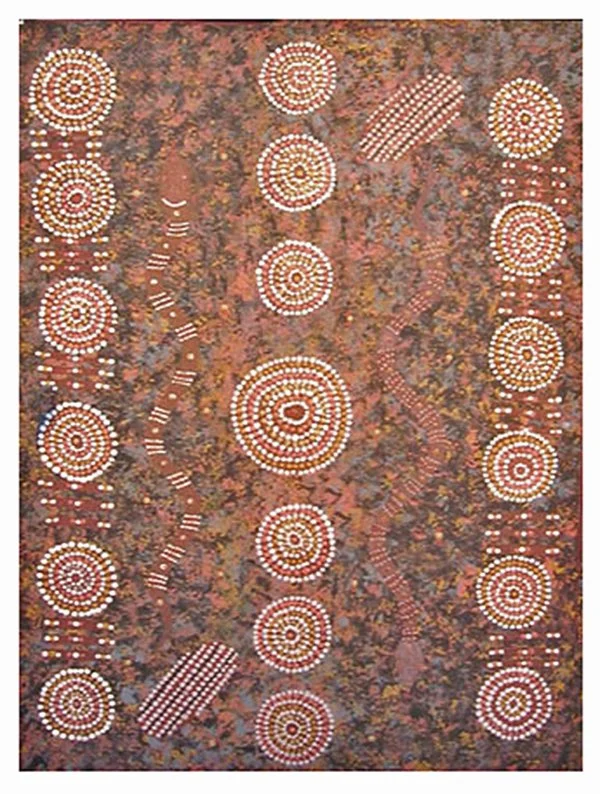
Australia/Central Desert, Dot Painting, "Snake Dreaming", acrylic on canvas, using traditional Aboriginal dot technique by Mervyn Rubuntja/Arrernte.
Virtually all Australian indigenous traditional dot paintings derive from "Dreamtime" stories or memory maps of the artists home country.
Mervyn Rubuntja was born at Telegraph Station in Alice Springs in 1958. Mervyn's father, Wenton Rubuntja (dec. 2013), a major figure in Aboriginal art and law, started his painting in the representational style of Albert Namatjira, evolving to traditional dot style over time.
Mervyn Rubuntja, on the other hand has moved in the reverse direction, evolving from dot style to representational style of the Hermannsberg landscape school. This is a rare, early work by Mervyn.
We guarantee both the authenticity of this work of art and your satisfaction with it if you purchase it.
If you are unhappy with it for any reason, let us know within 10 days and we will refund your purchase price as soon as the undamaged paining arrives at our base in Fort Myers, FL.
24" x 16" #K107RUBJ

Australia/Central Desert. Aboriginal indigenous dot painting on canvas, Wallaby dreaming at the site of Yarrungayi. by Don Tjungurrayi/Warlpiri.
Authentic Australian Aboriginal traditional dot paintings derive from "Dreamtime" legends that comprise the beliefs of the people or memory maps of the artist's home country, or a combination thereof. The roundels are said to represent caves in the country.
Don Tjungarrayi has been painting since the 1970s, winning the 1986 Alice Springs Art Prize. Don Tjungarrayi's work is in collections at the Kelton Foundation, National Gallery Australia, National Gallery of Victoria, Art Bank, Art Gallery of South Australia, Queensland Art Gallery, Museum and Art Gallery of the Northern Territory, Holmes a Court, Gallery of Western Australia and more.
Painted ca 1995, this work was acquired in 1995 from Papunya Tula, Alice Springs, NT, Australia.
We guarantee the authenticity of this work of genuine indigenous art. We also guarantee your satisfaction.
If for any reason you are unhappy with this painting, let us know within 10 days and we will refund your purchase price upon receiving the undamaged painting at our base in Fort Myers, FL
26” x 46” #AGK166

Australian Aboriginal dot painting on canvas, “Emu dreaming at Kanpi where emu ancestors gathered before traveling to Kintore”, by William Sandy/Pitjantjatjara.
William Sandy was born near Ernabella, South Australia ca. 1944. William Sandy started painting in 1975. working under the aegis of Papunya Tula in the 1980s. He has lived at Papunya in central Australia since 1973. At Papunya he married Violet Nakamarra, the sister of Michael Nelson Jagamarra, another well-known Aboriginal artist. William Sandy is also a knowledgeable traditional medicine man. This an authentic work of indigenous Australian Aboriginal desert dot artistry.
We acquired this painting from Papunya Tula in Alice Springs in 1994. It has been held under climate-controlled condition ever since and is in excellent condition
34" high x 10 3/4" wide #AGK168

Australian Aboriginal dot painting, “Ceremonial string dance dreaming”, acrylic on canvas, William Sandy/Pitjantjatjari.
This painting is remarkably detailed in its execution of Aboriginal dot painting technique. The color is both muted and vibrant, suitable for most decor color schemes
William Sandy is one of the most important indigenous Australian painters. He began painting for Papunya Tula, a pioneering Aboriginal artists cooperative, in 1975, and was one of the first Pitjantjatjara natives to become involved in the Aboriginal art movement.
Papunya Tula, where we acquired this guaranteed authentic William Sandy painting, was formed in 1972, owned and operated by Aborigines from the Western Desert.
We guarantee the authenticity of this work of indigenous Australian art.
We also guarantee your satisfaction. If you are unhappy with your purchase for any reason, let us know with 10 days and we will refund your purchase price upon receiving the undamaged painting at our base in Fort Myers, FL.
46 1/2" high x 26 1/4" wide #AGKB06
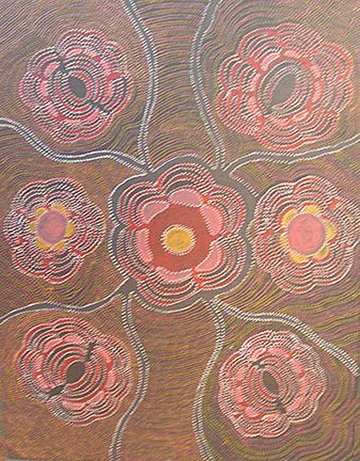
Australian Aboriginal indigenous dot painting, acrylic on canvas over art board. "Bush Tucker Dreaming", by Lucky Morton Kngwarreye/Utopia. Ca 2000.
Iconography in this painting, using traditional desert techniques of the indigenous Aboriginal people, represents important subjects, events and places in the artist's dreamtime stories. These are usually only fully revealed to senior members of the group.
Lucky paints stories from Ngkwarlerlanem and Arnkawenyerr, two countries in her lineage. She also has permission to paint ceremonial body paint designs belonging to these countries plus her mother’s country, Antarrengeny. Her work is in the Holmes a Court Collection among others. Exhibitions in Sydney and Melbourne have featured her paintings.
Lucky is the oldest daughter of Mary Morton Kemarre, also a Utopia artist of merit. Lucky transitioned from batik art to painting in the summer of 1988-89.
If you are unhappy with this painting after receiving it, for any reason, let us know within 10 days and we will refund your purchase price upon receiving the returned painting in undamaged condition.
23" x 18" #AGKB19

Aboriginal dot painting, acrylic on canvas, “Butterfly (Matimati) Dreaming”, by Anthony Nemarluk, Port Keats, western Northern Territory.
Could be a namesake of Nemarluk, a fierce Aborigine warrior who also inhabited the Port Keats area in the early 20th Century. Nemarluk was tried and convicted of murdering the crew of a Japanese fishing boat that anchored near his lands. He died in 1940.
Whether or not there was any relationship between Anthony Nemarluk, the painter, and Nemarluk, the warrior, does not diminish the striking beauty of this indigenous Aboriginal art painting.
The Aboriginal name for the community is Wadeye. We acquired this impressive work from the Wadeye Gallery in Darwin, NT, in 2001.
We have found the reference posted herein with some information about the artist. The source is no longer available.
Nevertheless, we guarantee the authenticity of this work of indigenous art and your satisfaction with it when you receive it. If you are unhappy with it for any reason, let us know within 10 days and we will refund your purchase price upon receiving the undamaged painting at our base in Fort Myers, FL.
24" x 38" .#AGKB45

Australian Aboriginal painting, acrylic on canvas, by Colin Warnir from Port Keats, NT, aka Wadeye, an Aboriginal community in western Northern Territory.
This is a hand-painted representation of waterlillies, from an indigenous resident of one of Australia's most remote communiies. The painting's sheer beauty attracted us to it when we visited the Wadeye Gallery. in Darwin, NT Australia, in 2001.
We were able to find the editorial material herein about the artist, Colin Warnir via an extensive internet search. We have been unable since to find the original or other references.
Nevertheless, we guarantee the authenticity of this art and artist information as presented here. We also guarantee your satisfaction when you receive it and can evaluate it in person. If you are unhappy with it for any reason, let us know within 10 days and we will refund your purchase price upon receiving the returned, undamaged painting.
24" x 36" #AGKB46
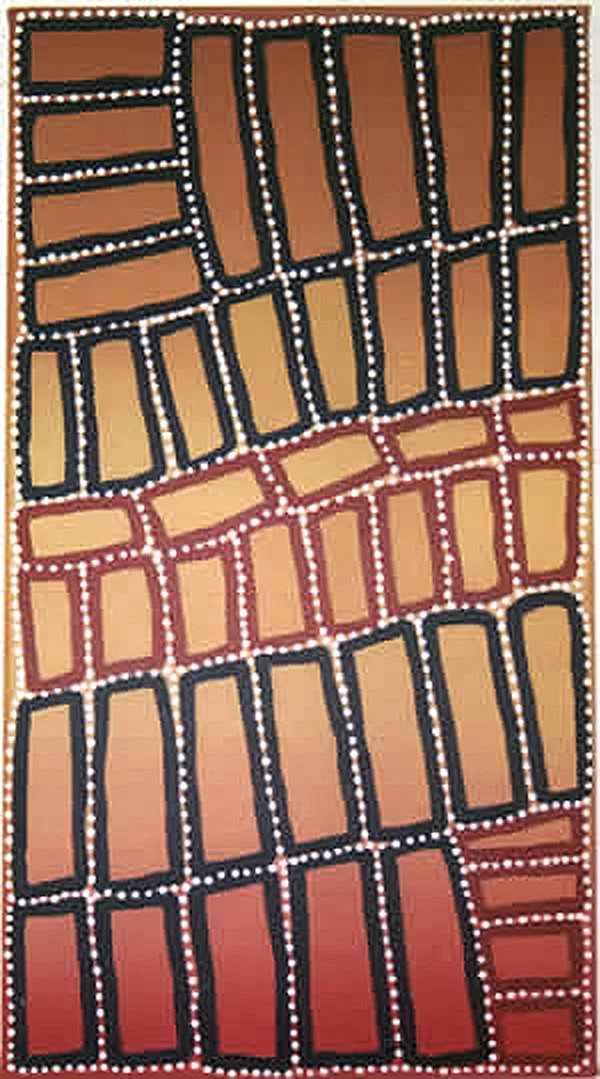
Australian Aboriginal Art Desert Painting “Tingari Cycle” by Walala Tjapaltjarri/Pintupi.
Walala Tjapaltjarri walked out of the Gibson Desert with his family in 1984, making their first contact with Europeans.
He began to paint his own works in 1996, following years of watching and helping the old men painters in Kiwrrikura and Kintore. His style is distinctive and recognized world-wide.
His subjects are Tingari Cycle stories, which recount travels during the creation time of a group of mythical characters of the Dreamtime. This painting depicts secret/sacred ceremonies associated with Tingari.
His paintings often sell for thousands of dollars in Australia.
We guarantee both the authenticity of this aboriginal painting and your satisfaction with it when you receive it in person. If you are unhappy with it for any reason, let us know within 10 days and we will refund your purchase price upon receiving the returned painting in undamaged condition.
42" x 24.5" #AGKB48

Australian Aboriginal acrylic on canvas dot painting, “Honey Ant Dreaming”, Janet Forrester/ Luritja Arrernte, Central & Western Desert / Ernabella.
Honey ants store sucrose in their abdomens making them an important source of sweetness and nutrition for Aborigines in the desert.
Janet Forrester was born in 1936. She started painting in 1980. Since the passing of her husband in 2003, she has devoted most her time to ceremonial and family matters.
Janet paints Dreamings of the Ernabella and Maryvale regions, stories inherited from her mother and grandmother. Her major Dreamings include Snakes, Honey Ants, Sugar bags, Bush Banana, Milky Way, Witchetty Grub and Goanna Stories.
Acquired in September, 2001 in Adelaide, Australia from the since closed Adella Gallery.
23" x 23" #AGKB86

Australian Aboriginal art dot painting, acrylic on canvas, “Bush Banana Dreaming” by Nancy Campbell Napanangka, Warlpiri/Anmatyerre language groups.
This is a Dreamtime story of Aboriginal women searching for bush banana fruit in the wild.. Bush bananas (yuparli) are roasted under hot coals and eaten when cooked. Taste is described as like stringy zucchini with echoes of pumpkin and beans.
The Napperby artist, Nancy Napanangka Campbell, was born ca. 1961. Her tribe and language is Anmatyere and she started painting ca. 1986.
Her works are exhibited in galleries across Australia. Her Woman’s Ceremony paintings are celebrated both nationally in Australia and in overseas venues.
48 1/2" x 18" #AGKC36

Australian Aboriginal art dot painting. “Bush Tucker Dreaming”, polymer on canvas, by Amy Pultara Napaltjarri.
Amy is a senior in the Anmatyerre language group. She has painted this Bush Tucker Dreaming with iconography reflecting women's dreaming. Several women sit by coolamons (food carriers) and dance strings.
Amy was born at Mt Denison Station in 1955. As an Anmatyerre language speaker and longtime resident of Napperby - Larumba, Amy paints mostly dreaming's from this area.
Amy Pepperil Pultara is an Indigenous Aboriginal Australian artist who was born in 1951. Amy Pepperil Pultara's work has been offered at auction multiple times, with realized prices depending on the size and medium of the artwork.
36" x 24" #AGKC37

This Australian Aboriginal art dot painting is acrylic on canvas, by Brenda Nungala. It is Bush Banana Dreaming or "Kunga Juta". Brenda Nungala is the daughter of well-known and highly regarded indigenous artist, Pansy Napangardi.
Brenda has painted this very vibrant, eye-captivating Bush Banana Dreaming painting with iconography reflecting a traditional women's dreaming. We acquired this authentic work of aboriginal art from Muk Muk Gallery in Darwin, NT Australia. It has been stored in climate-controlled storage since then.
We guarantee it's authenticity and your satisfaction. If you are unhappy with it for any reason when you receive it, let us know within 10 days and we will refund your purchase price upon.return to us in undamaged condition.
30" x 40" #AGKC42
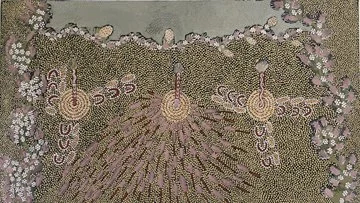
Aboriginal art dot painting, acrylic on canvas, by Sonder (sometimes spelled “Sonda”) Turner Nampitjinpa/Warlpiri. The Dreaming is a women's story. U-shapes represent women dancing around ceremonial poles. Berries that are used as food are shown around the painting.
Born in 1956, Sonder is the daughter of Paddy Tjangala. Taught to paint in the early ’80s by her father, Sonder was one of the first women painters in the Western Desert style to gain recognition for her work, winning the 1986 Canberra National Times Art Award.
Her paintings usually depict the Two Women Dancing story for Mt Liebig. A Warlpiri speaker, she moved to Darwin in 1986 and thence to Katherine. A Walpriri woman, Sonder Turner Nambitjinpa was born at Yuendumu, living there until the age of 4 when her family moved to the Papunya settlement.
Sonder started school when she turned 5. Her parents worked from 1959 to 1969 for milk, flour, sugar and tobacco. In the 70’s, Sonder’s family joined the migration to Papunya, where a teacher, Geoffrey Barden asked Sonder’s family to paint a building followed by painting on paper and board. Sonder saw her uncles Paddy Carroll Tjungurrayi and Two Bob Tjungurrayi selling their paintings in Papunya Tula Art Gallery.
“I started painting after watching my uncle and my uncle told me this is how you’ve got to paint it. You’ve got to paint your grandfather’s Dreaming and your grandmother’s Dreaming and don’t copy other people’s painting or other people’s Dreaming. You get in big trouble.”
Sonder moved to Darwin in 1978 to start a new life being only 16 years old. where she met her husband. who she married in 1994. Sonder regularly returns to her home country and Alice Springs, as do many clan elders.
#AGKC89 48" x 28"

Australian Aboriginal dot painting, large, acrylic on canvas, signed "Lucy" Acquired in 2001 from the private collection of dealer Tony Bond, Adelaide, SA
The dreaming is not known but appears to be an initiation ceremony, with roundels representing sacred meeting places or waterholes. U-shapes symbolize people seated around the roundels with various implements. The "chains" between roundels may represent tracks traveled by the clan members in the ceremony.
This is a very large canvas that would dominate a wall (or room). The signature does not include the surname of the artist, suggesting she was well known by her first name at the time. Possibly Lucy Kennedy Napaljari.
In a post-purchase email conversation with Tony Bond, he opined that the painting was from Utopia (or Yuendumu), based on its "style". He was unable to be more precise because of the passage of time. Additional attempts to attribute the painting through email contacts have been unsuccessful.
Recent online investigations lead us to believe the artist who created this painting was Lucy Kennedy Napaljari based on stylistic and palette similarities. We always welcome additional input from anyone, anywhere.
49" x 43" #AGKC90

Australia/Great Lakes, dot painting, acrylic on canvas, “Spiritual Lands”.
This is a Westernized variation, portraying a symbolic landscape, in traditional Aboriginal dot painting technique, by Len Cunningham/Worimi, ca. 1999.
Traditional Worimi tribal lands are on the east coast of New South Wales, to the north of Sydney. Newcastle is the modern city that developed within or adjacent to these lands.
As a result, Worimi people today are primarily urban. Worimi paintings display the influences of European-Australian culture in adapting dot technique to hybrid approaches to the canvas.
We acquired this unique authentic work of Aboriginal art at Tobwabba Gallery in Adelaide, South Australia, in September 2001. It has been held in climate-controlled conditions since then and is in excellent condition.
35" x 24" #AGKA28

Australian Aboriginal dot painting, “Honey Ants Escaping”, acrylic on canvas, Linda Currie/Worimi.Katang.
This is a Westernized variation of traditional Aboriginal dot technique, portraying echidnas at a honey ant nest by Linda Currie. Acquired in 2001 at Tobwabba Gallery in Adelaide, South Australia.
The Worimi people are indigenous Australians whose historical homeland was on the east coast of Australia, north of Sydney, it is an area also known as the Great Lakes in reference to the lakes that dot the area. It is situated not too distant from the famed Hunter Valley wine growing area.
Worimi connections to the land, the sea, nature and traditional Aboriginal beliefs are reflected in this painting, as are the evolving urbanization of this Aboriginal community.
Echidnas are natives of Australia and New Guinea. Their spiny backs and pointy snouts often lead to them being misidentified as porcupines or hedgehogs. In fact, they are not related. Echidnas belong to the Tachiglossidae family, Greek for “fast tongue.” Echidnas uses their beak and sticky tongue to eat ants.
22" x 23" #AGKA29

Aboriginal art dot painting, Worimi people. "Birthing of the Turtles", acrylic on canvas by Loretta McDonald. This is a Westernized variation with 4 swimming turtles, in traditional Aboriginal indigenous dot technique.
Worimi traditional lands are north of Sydney, an area of abundance of lakes and called the Great Lakes. Because it was near early urban settlements of British settlers, the art reflects European influences, such as the graphic elements in this nature-lover's depiction.
We acquired this almost vintage authentic work of Australian indigenous Aboriginal art at Tobwabba Gallery in Adelaide, South Australia in September 2001.
23” x 23” #AGKA31

Australian Aboriginal Tiwi/Melville Island painting, 4 butterflies, gouache on paper. Karen Puruntatameri.
Karen Puruntatameri, was born in 1973, the daughter of the late Eddie Puruntatameri and Maree Puruntatameri. She produces art reflecting influences from her Tiwi father’s style and her Arrente (Central Australian) mother’s work.
She started at Munupi Arts & Crafts in 1994, following her family tradition in decorative pottery, painting and printing.
14" x 11" #AGKD53

Australian Aboriginal Tiwi, painting, gouache on paper by Shirley Puruntatameri (nee) Tipungwuti, Melville Island, Australia. “Jilamara”, bird and snake.
Shirley Puruntatameri is an Aboriginal Australian artist born in 1959. She is a prolific painter of Jilamara, a Tiwi ceremonial design. This work, which was done on Melville Island, where we acquired it, incorporates some Jilamara design in the feathers of the bird.
During Tiwi Islands ceremonies,' yoi' (dances), are performed. Dancers are painted with turtiyanginari (the different natural ochre colours) in varying designs, transforming them or protecting them from being recognized by mapurtiti (spirits).
These designs can be applied in ochre to body and face. These designs are called 'Jilamara'.
We acquired this work for our retail gallery inventory in 2001. while on a buying trip to the Tiwi Islands.
22" x 15" #AGKD58
Australian Aboriginal Bark Paintings
Bark paintings are indigenous to the North of the continent, where the tropical weather fosters the growth of gum trees. During a period of the seasons the bark of the gum tree can be scored and stripped in large sections from the trees.
These slabs of bark are well-suited to provide shelter from the tropical rain that drenches the land. The inner side of the bark is cleaned to provide a smooth surface that becomes the medium for Aboriginal artists to illustrate their dreamtime stories while sharing them with youngsters and those being initiated into Dreamtime tales. The bark paintings shown below represent different styles as used by different clans of the Aboriginal community. Each is significant to the artists and communities and worthy of identification of each painter's creative output.
Important Notes: All of these works, which were acquired by us whilst living and traveling in Australia, have been held in climate-controlled environments in the United States for decades, which means any purchaser in the USA will not have to contend with cross-Pacific shipment, customs duties or import delays.
Sizes of the thumbnails are not proportional or relational. Please read the actual dimensions to know the actual dimensions of each work of art.
For a larger image, more information
& prices, click on any small picture below

Australian Aboriginal painting in natural ochre, charcoal and kaolin with natural binder on Eucalyptus bark. This painting, “Turtle Dreaming”, portrays a totemic long-neck turtle accompanied by clan-specific "rarrk" patterns.
Acquired in 1990 from Aboriginal Arts Australia Limited in Darwin, NT.
Attributed to George Liwukana and Steven Wurraki from Elcho Island.
Bark paintings are a venerated tradition among all Aborigines of the Far north in the Northern Territory. Elcho Island is a major island in the Arafura Sea, not far from the northeast coast of Arnhemland.
Many different indigenous clan ethnicities reside there, some of whom migrated from Tiwi homelands to escape the violence of WWII bombings of population centers and military installations.
Tiwis have a distinctly different culture and different art traditions, as reflected in this work. Eucalyptus bark is the medium because of the remoteness of the islands and the shortage of other materials to paint on. Most barks are secured from warping by attached branches from the underbrush.
23" x 21" #AGCY76
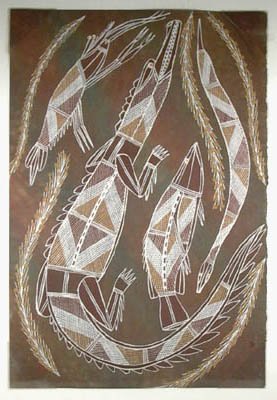
Australian indigenous bark-style painting on archival paper. ca. 1994 by Larry Nalorlman of Arnhemland/ Oenpelli/ Kunjwinjku people, Yolnga. Acquired personally at Framed Gallery, Darwin, NT, Australia in 1994.
Portrays a crocodile surrounded by other creatures of the sea. The painting uses a technique of cross-hatching to replicate the inner organs of the creatures.
Bark can only be harvested as a medium for bark paintings during the wet season.
When it is not available, artists paint Dreamtime subjects on archival paper, which is supplied by art supply vendors that travel to the remote communities.
The reverse describes the subjects as crocodile, yabby, barramundi and fresh-water eel. A closer view has been included to show the technique used by the artist.
16" X 24" #AGK151

Australian bark-style painting on archival paper, by Eddie Blitner/Roper River/Arnhemland/Oenpelli/ kangaroo, xray style.
Archival paper is substitutes for bark, which is only available when it can be removed from the eucalyptus tree in the wet season.
Acquired personally at Aboriginal Fine Art Gallery, Darwin, NT, Australia, ca.2001
Please note: This work has been covered temporarily by cellophane to protect its surface. That also distorts the refraction in the photo somewhat.
Eddie Blitner was born in 1961 in Naiyalrindji, Ngukkurr Community, Roper River, NT.
Eddie began to paint at about age 7, by watching and listening to his grandfather paint on bark. At age 16, he started painting "Dreamings" from his grandfather. Eddie is also woodcarver.
X-ray style depicts the skeletal framework of the animal. Iy used to teach youngster what part of a kill is most edible.
9" X 6.5" #AGKB58

Australian Aboriginal bark painting in ochre, charcoal and kaolin with natural binder. by Gawirrin Gumana . Originally acquired personally at Buku-Larngay Art Center, Nhulunbuy, Northern Territory, Australia, in 1994.
This Painting on bark created by Gawirrin Gumana (1935–2016) of Dhalwaŋu clan, Yirritja moiety, Yirrkala, portrays two Dreamtime brothers who travelled in a canoe to visit the Milkyway. They have two fish for sustenance and are surrounded by icons of indigenous legends.
Gawirrin Gumana, the eldest son of Birrikitji, was the oldest surviving painter of the Yirrkala Church Panels (1963). He won the Telstra National Aboriginal and Torres Strait Islander Art Award in 2002. A year later he received the Order of Australia for his services to Indigenous art and he was named for the Clemenger Contemporary Art Award. In 2009, he won the Red Ochre Award.
We originally acquired this guaranteed authentic Aboriginal bark painting from Buku-Larrngay Art Cooperative, where upon it was immediately purchased by an employee in our Sanibel Island Gallery. When she passed, (name available on request) we acquired it again from her estate.
A Certificate of Authenticity will be provided.
38" x 19" #AGKD71

Australian Aboriginal painting on bark in ochre, charcoal and kaolin with natural binder by Djutjadjuta Mununggurr Djapu/Wandaway/Dhuwa. (b. ca.1935 - d.1999) Portraying sacred waterholes in traditional rarrk and iconography, on bark from a eucalyptus tree, secured by sticks on each end.
"The Djan'kawu brother and two sisters travelled from spirit island Burralku,
to Yalangbara on the east of Arnhemland, then North and West to Ramingining. As they traveled, they marked the country, leaving behind waterholes, species, sites and sacred objects. The Djank'kawu made the country rich and fertile."
Marked as Djutjadjuta Mununggurr on reverse by Nambara agent , well-known to those who follow Australian Aboriginal "bark" art. Djutadjuta was a winner of top honors in the National Aboriginal and Torres Strait Islander Art Award and is recognized as mastering the fine cross-hatching of the Yirrkala people. His work also benefited from the help with the fine cross-hatching rrark by his wife, Nonggirrnga Marawili.
“We should not imagine these paintings to be records of an historical or mythical past. For Marawili and her peers what happened in the distant past is still happening today and will continue to happen in the future. The land is alive with spiritual presences that must be respected by the artist. Different clans are assigned custodianship of particular motifs, which cannot be depicted by outsiders without permission.”
- John McDonald, Sydney Morning Herald,
Jan 18, 2019 in reference to work by
Nonggirrna Marawili, Djutjadjuta's wife.
This work was done ca. 1989. Acquired personally at Nambara Art Center, Nhulunbuy, Northern Territory, Australia, in 1990.
38" x 19" #AGW724

Australian Aboriginal bark painting, natural ochre, charcoal and kaolin with natural binder.
Mimihs and hunters by Djawida Nadjongorle./Milingimbi/Kudjekbinj (d. 2008). Acquired personally in 1989 at Framed Gallery, Darwin, Northern Territory, Australia. Signed “Djawida” on the reverse.
Djawida was born ca. 1943 in Dialbangurr, his father's country. His family moved to Oenpelli where his mother and father worked. Djawida went to school in Oenpelli with occasional visits to their country. That's where Djawida became interested in painting, first painting on rock, in the manner of his ancesters, including hand and foot stencils.
Djawida learned to mix ochres and paint, evolving to bark painting. He painted stories from his father's country, and his mother's country (Kudjekbinj) and his grandmother's country near Manmoyi.
Before passing in 2008, Djawida was a highly respected painter in his genre and is represented in many world class collections.
69" x 22 #AGW752
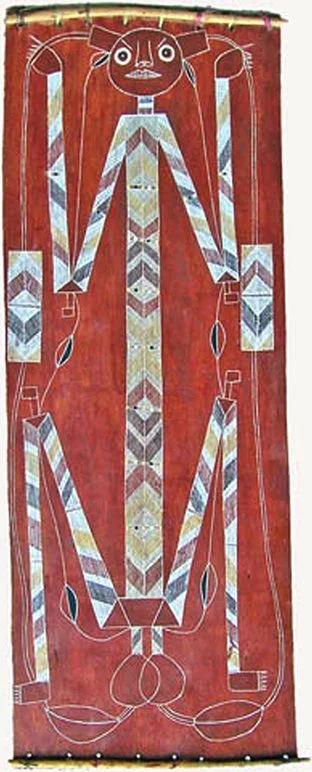
Australian Aboriginal bark painting, "Namarrkon - The Lightning Spirit", in natural ochre, charcoal and kaolin with natural binder. Signed “Neville Mardday” on the reverse.
Neville Mardday (aka Neville Marrday, Neville Marbday, Neville Mardai) is Kunwinjku/ Oenpelli/Namugarbadu, born ca. 1935.
We acquired this impressive authentic work of indigenous art personally at Raintree Gallery, Darwin, NT Australia in 1990
"When the wet monsoon season starts to build up in November, Namarrkon flies up into the sky and sits on storm clouds made by the Rainbow Serpent. From there he emits deep growls of thunder and sends lightning flashes across the sky, although no rain falls until the Rainbow Serpent releases it. This high vantage point allows Namarrkon to keep a close watch on the Aboriginal people living below to see if they are observing codes of good behaviour, conducting sacred ceremonies, and passing on history and religion to the uninitiated in their tribe. If Namarrkon sees anything which displeases him, he plucks one of the stone axes from his knee or elbow joints and hurls it at the offender. Sometimes he misses and cleaves a tree in two."
(Source: Wisdom from the Earth, Voigt & Drury)
Bark paintings are created by stripping bark from a eucalyptus tree, flattening it, cleaning it and painting with, natural pigments, then securing with sticks at each end.
We guarantee both the authenticity of this bark painting by indigenous artist Neville Mardday and your satisfaction with it when you receive it.
If you are unhappy with it for any reason, let us know within 10 days and we will refund your purchase price as soon as the undamaged painting arrives at our base in Fort Myers, FL.
17 1/2" x 47 1/2" #AGW758

Australian Aboriginal bark painting, “Kangaroo of the Dreamtime”, natural, ochres on eucalyptus bark, Luke Nganjmirra / Oenpelli / Gunwinggu, kangaroo and mimi in x-ray style, ca. 1990.
The Nganjmirra family of West Arnhemland in Australia's Northern Territory has been a powerful force in the promulgation of Aboriginal art from the area of the Kunwinjku people. Luke Nganjmirra is a Kunwinjku painter, member of the family also associated with Injalak Arts & Crafts.
Nganjmirra artwork features rock art themes, mimih spirits, x-ray styles and djang (ancestral stories).
This one shows a kangaroo in x-ray technique, mimihs, dilly bags, elongated feathers and what appears to be a jabiru bird.
We inserted a closeup of the "intestinal" section of the kangaroo to show the technique used to be able to use the painting as a teaching tool for young members of the clan.
We acquired it personally at Raintree Gallery in Darwin, NT, Australia in 1990
We guarantee the authenticity of this artwork, which has been verified by respected Aboriginal Art Assessor, Dorothy Bennett. Documentation available.
We also guarantee your satisfaction with it when you recieve it. If you are unhappy with it when you receive it, let us know within 10 days. We will refund your purchase price when the undamaged painting arrives at our base in Fort Myers, FL
42 1/2" x 21 1/2." #AGW769

Australian Aboriginal bark-style painting on masonite in ochre, charcoal and kaolin with natural binder.
This work was painted ca. 1989. We acquired it personally at Nambara Art Center, Nhulunbuy, Northern Territory, Australia, in 1990.
Its meaning was explained to us by the artist, Dhuwarrwarr Marika, in person. The explanation began at a normal conversational volume gradually becoming quieter until it was inaudible, the artist's technique for being hospitable but not revealing information only permitted to be revealed to senior clan members. The art advisor summarized the explanation as relating to Milyurr, a sacred water source.
The photo shows the work and the artist, Dhuwarrwarr Marika standing next to it..
We guarantee the authenticity of this work of indigenous art and your satisfaction when you receive it.
If there is anything about this painting or transaction that displeases you, let us know within 10 days and we will refund your purchase price as soon as the undamaged painting arrives at our base in Fort Myers, FL.
35.5" x 23.5" #AGW812

Australian Aboriginal bark-style painting, “Sugar Boy” (Wuyal). Natural ochre, charcoal and kaolin with natural binder on art board. by Nirritja Wanambi.
The subject is Wuyal, (Creator Ancestor) also known as the Sugar Boy because of the sugar bag around his neck. Recalled in the Dreamtime stories of the Yirrkala people. As Wuyal travelled through Marrakula clan land, Wuyal downed trees to get the honey hives. Rivers formed where the trees fell.
We acquired it personally in 1990 at Buku-Larrngay Arts, Yirrkala, NT, Australia. (Independent documentation available). Please note this work has already been mounted and framed.
Wanambi is a common name among the Aborigines of Arnhemland. Extensive search has failed, however, to provide further information about this artist. We must rely on the considerable integrity of Buku-Larnngay Arts for provenance.
16” x 12”, #W813

Australian Aboriginal painting in natural ochre, charcoal and kaolin with natural binder on bark. Dhuwarrwarr Marika /Dhuwa moiety/ Yirrkala. Portrays a Bolyu (water spout) Dreaming, on eucalyptus bark secured by sticks to keep it from curling. Painted ca 1989 .
Dhuwarrwarr Marika is a very significant Aboriginal artist. Born ca 1946, she is the daughter of Mawalan (d) and one of generations of the Marika family that have presented the clan's story in art. She was a nurse at Yirrkala, Darwin and Sydney before returning home to nurture her artistic talents. She learned Rirratjingu painting from her father, Mawalan 1 Marika.
Her earliest paintings were done in the 1970s. Her work has been included in shows in most Australian state galleries since the late 80s. She's a devoted mother and grandmother who believes her art is important in passing on her culture and promoting it to the outside world.
We had the pleasure of meeting her in person when acquiring this painting at Buku-Larrngay Arts, NT, Australia. At that time, she explained to us a secret, sacred painting (not this one), burying the meaning of its most secret parts by lowering her voice to inaudible as she described it.
24” x 11 1/2’ #AGW816

Australian Aboriginal bark painting, Freshwater Totems, in natural ochre, charcoal and kaolin with natural binder. Dhakuwal Gumana./Gan-Gan/Yirrkala. ca.1989
Bark is stripped from a eucalyptus tree, flattened, cleaned and painted, then secured by sticks at each end.
"Special painting of a freshwater totem such as freshwater longnecked-turtle, frog, freshwater crayfish, diver-duck, Saratoga fish."
The clan design represents freshwater and reeds, which belong to the Dhalwangu clan, group and Country.
Provenance verified by Buku-Larrngay Art Centre, Yirrkala, Nhulunby, Northern Territory, Australia
36" x 17" #AGW818

Australian Aboriginal bark painting, "Milngunya (Milky Way) Dreaming." Jakarppi. Naminapu Maymuru & Wukun Wanambi (d)/ Nhulunbuy-Gove, artists of the Yirritja ga Dhuwa moiety. The painting depicts the creation of the Milky Way. When a Mangalili person dies, his or her spirit goes to the Milky Way.
Wukun Wanambi was a highly regarded Aboriginal artist, who was fluent in film-making as well as more traditional indigenous genres. He traveled to New York City and shared his native culture on public media. Wanambi was born in Gurka'wuy as the oldest son in his family. His father, Mithili Wanambi (d.), was an esteemed clan leader and renowned painter. Although he was born to a family of artists, he wished to be a politician growing up.
When Mithili died in 1981, sacred clan designs could no longer be painted because no one had the authority to paint them any more. It was not until 1997 that Djunggayi (caretakers and preservers of clan knowledge) taught Wanambi the designs. Wanambi then began painting and created for the Saltwater Country exhibition, re-introducing motifs that had not been painted since his father's death.
From this point on, he became a highly renowned artist, dedicated to honoring his father and ancestry through his art.
Naminapu Maymuru-White is an Aboriginal Australian Indigenous painter born a member of the Mangalili clan, at the Yirrkala mission station in Northeast Arnhem Land in Northern Australia in 1952.Naminapu is an extremely versatile artist with skills in the areas of painting, carving, screen-printing, weaving, lino-cuts and batik work. As a child she sat for hours patiently watching her father paint.
At about the age of 12, she began to learn herself, and was fortunate in being taught by her father’s brother, Narritjin Maymuru, as well as by her own father, Nånyin Maymuru. Both men were extremely able and well-known artists, whose works hang in many Australian and overseas museums. After attending the mission school, she worked for some time in the store and craft shop and also helped out in the local bank.
When the Homeland Centre of Gurka’wuy was established in 1973, Naminapu went to live there with her husband and young family of three children. During the years she spent there, Naminapu worked as a teacher trainee and later, on her return to Yirrkala, completed her teacher training. When she later married Leon White, a teacher in the Northern Territory, Naminapu went to live for several years in Melbourne and Darwin.
44 1/2" x 22" #AGW821

Australian Aboriginal painting in natural ochre, charcoal and kaolin with natural binder on eucalyptus bark. "Crocodile Dreaming", by Burruwanga (Tiwi) of Millingimbi, NT.
We acquired this painting in 1990 from Aboriginal Artists Gallery, Darwin, Northern Territory, which provided provenance..
The design portrays a pair of totemic crocodiles and a log over a background of sacred, clan-specific rarrk patterns.
Barks are painted after being stripped from a Eucalyptus tree trunk during the wet season, flattened and scraped clean on the inner side.
45" x 21" #AGW950
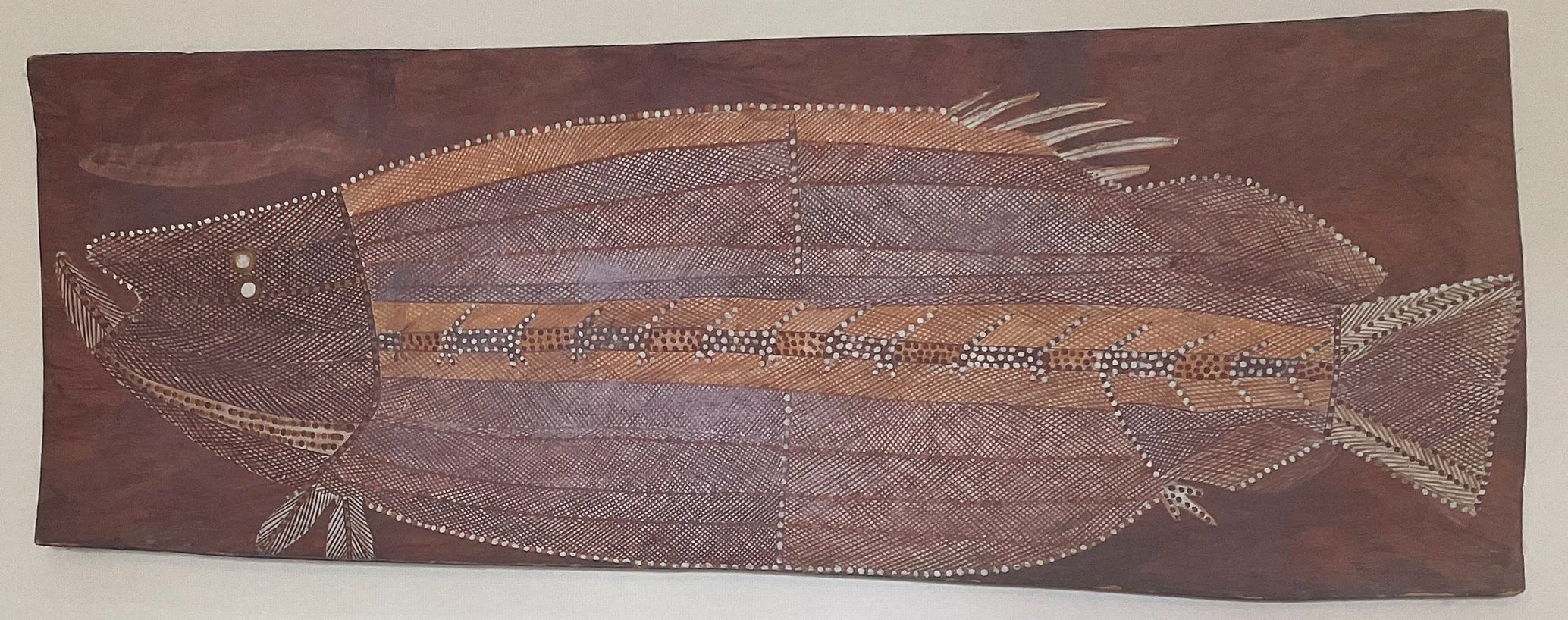
Australian Aboriginal painting on bark, barramundi, x-ray style, Peter Marralwanga, ca. 1970s.
We acquired this painting from the artist at a presentation in Adelaide, South Australia, in 1976.
Peter Marralwanga (1916–1987), also known as Djakku (meaning left-handed), was a Yolgnu artist known for his painting.
Born in 1916 in West Arnhem Land in the Northern Territory of Australia, Marralwanga was influenced by Yirawala, a fellow artist and elder in his community.
He is best known for his creation of paintings both on paper and bark. Those works reflect the artistic practices of his elders and community with elements of ceremonial and spiritual creatures alongside the cross-hatching pattern known as rarrk.
Barramundi are native fish in the waters of Australia. They are delicious and highly favored in Australian restaurants.
This a noteworthy example of using a technique called "x-ray" to reveal the edible parts of the fish.
12 1/2” x 36” #AGW037
Australian Aboriginal Prints
Print making is a growing art activity for indigenous Australian artists, especially among the Tiwi people of Bathurst and Melville Islands. Their works tend to feature native Australian creatures or mythic scenes. Typically, prints are more affordable than original works yet reflect the artistry of the painter or print maker.
For a larger image, more
information & prices, click
on any small picture below

Australian Aboriginal print on matte paper, shark, by Samson Poantumilui, Tiwi. #37 of 250. An identical print, #18 of 250, is also available
Bathurst and Melville are two islands in the Arafura Sea that make up the Tiwi Islands. They are about 45 minutes by light aircraft from Darwin on the Australian mainland.
The pass between Bathurst and Melville Islands is notorious for being shark-infested. A fact instilled in the thoughts of Tiwi children in order to keep them safe.
Tiwi Islanders have become quite proficient at print making, a fairly recent addition to their menu of artistic endeavours. The Poantumului’s are among the most avid print makers of Tiwi.
9"x 9" #AGKD46

Australian Aboriginal print, “Radjarra”, by indigenous Doris Gingingara, color lino reduction,#31 of 95 . Ca 1994. The fish are barramundis, a favorite fish for eating by Australians.
Doris Gingingara was born ca. 1946 at the Northern Territory Arnhemland Aboriginal community of Maningrida. As a child, she learned the lifeways of the Barada people.
Her art has been inspired by her surroundings, Dreamings, and an Aboriginal woman's perspectives of Mt. Magnet, the mining town that was her home until she died in 1999.
This work was one of a series of four with seasonal themes. The other three works have been acquired by previous buyers. Doris Gingingara's work is included in collections at Artbank, Sydney; the National Gallery of Australia, Canberra; the Art Gallery of Western Australia Perth and Flinders University Art Museum in Adelaide.
22” x 28” #AGE446

Australian Aboriginal linocut print, “crocodile hatching”, by Anne Gela of Torres Strait, Australia. #18 of 30. Signed “Gorli Kana Anne Gela” and titled “KOEDAL Crocodile Hatching” in the bottom margin. Ca. 1994 by Anne Gela.
Anne Gela is a native Torres Strait Islander, born in 1953 on the island of Moa (aka Banks Island), off the coast of Queensland, Australia. She is a member of, and was a founder of, Saima Torres Islander's Corporation, Rockhampton, QLD.
This linocut print was acquired at Coo-ee Gallery in Sydney, New South Wales, Australia. It is mounted on 1/4" foam board., which is shown in the full photo (slightly distorted by the camera angle). A close-up photo is also included to show the remarkable detail.
We guarantee the authenticity of this print and also guarantee your satisfaction when you receive it. If for any reason you are unhappy with this print or the transaction, let us know. We will refund your purchase price when the undamaged print arrives at our base in Fort Myers, FL.
22” x 30” #AGK114

Australian (Torres Straits) Linocut Print, “Circle of Life”, "Ngw Kukuwum", based on an Aboriginal Dreamtime story, signed 1993 by Dennis Nona. Authenticity Guaranteed.
Dennis Nona was born on the Torres Strait Island of Badu in 1973. He learned traditional wood carving. Combining his cultural background of traditional narrative and native ceremonies led to linocut skills with detailed style. He became an important preserver of the Torres Strait Islander legends.
It has been written he is "widely acknowledged to be one of the most important Torres Strait Islander artists. His skill and constant innovation have resulted in works of great beauty and complexity."
Anchored in his native culture, Dennis Nona's oeuvre evokes the ancient myths and legends of his islands. Whereas traditional Torres Strait Islander art would be based on a single image, he is able to relate an entire narrative in one graphic work. His incredibly intricate and beautiful linocuts, etchings and sculptures are being collected by major Australian museums and international institutions。
Dennis Nona has gained wide recognition and received major awards such as the prestigious Telstra National Aboriginal and Torres Strait Islander Art Award in 2007, 2008 and 2010.
In an interesting 21st Century twist, Nona's reputation has been caught up in contemporary "cancel culture". Despite his considerable contributions to Torres Strait culture and art, evidence of alleged felonious behavior when he was a young university student led the National Gallery of Australia to remove his art from its collection.
Depending on how you feel about cancelling art because of historical behavior of the artist, you will find Nona's work either less valuable or more valuable. Nevertheless, we feel obligated to reveal the situation to any potential buyer of this substantial work of art.
25" x 21" #AGK115

Australian Aboriginal print, color lino reduction, "Muputi" (fish), matted, by Fiona Puruntatameri, Tiwi. #22 of 27.
Fiona was born 1973 in Tiwi. She left school in 1988 to work at Nguiu Adult Education Centre, before joining Minupi Arts & Crafts. She participated in the Canberra printmaking workshop held in 1991.
As of this writing, Fiona was completing her Certificate II in Arts and Crafts with Batchelor College. Her partner is Declan Apuatimi, son of the renowned Declan Snr and Jean Baptiste Apuatimi.
14" x 19 ½", #AGK131

Australian Aboriginal print, color lino reduction, "Yikikini" (White Cockatoo) by Reppie Orsto, Tiwi, #22 of 24.
Reppie Papajua (Orsto) was born on Bathurst Island in 1959 where she grew up until she was a teenager and her father moved the family to Pirlangimpi, Melville Island. Reppie Papapjua has worked at Munupi Arts & Crafts since its beginning in 1985.
In those early day of Munupi Arts she produced numerous intricate fabric and t-shirt designs as well as paintings. Reppie Orsto participated in Munupi’s first printmaking workshop in Canberra in 1990.
In June 1992 she attended the opening of the Munupi Exhibition at The Australian Embassy in Paris, France. In 2002 Reppie Orsto had her first solo show in Melbourne, VIC.
This particular print was being created by Reppie Orsto in 1994 while we watched in the studio on Melville Island.
18 1/2" x 22 1/2" #AGK133

Australian Aboriginal Tiwi print, “Takaringa”, Thecla Puruntatameri.
Thecla Puruntatameri was born in 1971 on Bathurst Island in the Tiwi Islands, which are located approximately 45 minutes by small aircraft from Darwin, NT. She was an artist at Munupi from 1989 to 1994.
Thecla Puntatamari worked extensively in screen prints, such as this one, etchings, linoprints, paintings and pottery.
Her work is in numerous private and public collections throughout Australia and internationally.
She now teaches at the Pirlangimpi School in Tiwi.
12 1/2" x 17" .#ADKD61

Australian Aboriginal print from Tiwi Islands, “Mupati” Susan Wanji-Wanji.
Susan Wanji-Wanji was born in 1955 in Arhemland, NT, Australia. She grew up in the Tiwi community of Maningrida on the north coast of the mainland.
She is a multi-talented artist with works ranging from woven baskets to tunga bark baskets. She has worked in the Tiwi Islands and Arnhemland.
Her work shows influences from both areas. This print was acquired at Melville Island's Munupi Art Centre.
In 2013. she was a finalist in the prestigious Telstra Aboriginal and Torres Strait Islander Art Award Competition.
Her paintings have been valued in the 1,000s of (Australian) dollars and are represented in many national as well as international collections.
12 1/2" x 16 1/2". #AGKD62
To navigate from this page, use the links below.
AUSTRALIAN ABORIGINAL ART
AUSTRALIAN INDIGENOUS FOLK ART
HOPI INDIAN FOLK ART
NAVAJO FOLK ART
PACIFIC COAST FOLK ART
PLAINS INDIAN FOLK ART
WOODLANDS INDIAN FOLK ART
ZUNI FOLK ART
HOME PAGE
Australia, Papunya, Central Desert. Christine Peterson Nungala, Luritja/Amunturrngu, indigenous Aboriginal art dot painting, acrylic on canvas, mounted on art board. "WATER DREAMING" 18" x 28" - #AGKB14
See additional info for shipping considerations.